

Dietary fibre
Scientific classificationJune 2026
Introduction
Dietary fibre is a significant component of health-promoting nutrition. In its reference values, the Deutsche Gesellschaft für Ernährung, DGE (German Nutrition Society) recommends adults to eat at least 30 g per day [1]. Based on data from the Nationale Verzehrsstudie II (German National Nutrition Survey II, for the period November 2005 to January 2007), these recommendations are not being implemented: women have an average intake of 18 g of fibre per day and men 19 g. Bread is by far the most important source of fibre, followed by fruit, vegetables, cereals and baked goods (in descending order, consistent for both women and men) [2, 3]. There are currently no more representative up-to-date data on fibre intake in Germany.
In the long term, an increase in dietary fibre intake goes hand-in-hand with diverse physiological effects that are reflected in a reduction in various health risks. Although the absence of dietary fibre does not trigger any immediate deficiency symptoms, low intake is considered a significant risk factor for diseases partly related to nutrition [4], such as cardiovascular diseases, Type 2 diabetes, obesity and certain types of cancer, especially colon cancer [5-9].
Information on the fibre content of food is normally recorded in nutrient databases. The Bundeslebensmittelschlüssel (BLS, blsdb.de) is Germany’s national nutrient database and is developed and maintained by the Max Rubner-Institut (MRI). It currently contains nutrient data on more than 7,000 foodstuffs, including the contents of dietary fibre. With the release of version 4.0 in December 2025, the dietary fibre nutrient group was also updated to align the data with the new scientific definitions. This was necessary in order to contain data on dietary fibre that comply with the Lebensmittelinformationsverordnung (Food Information Regulation, Regulation (EU) Nr. 1169/2011).
For this purpose, fibre content was gradually updated based on analytical data measured using the method recommended by the Codex Alimentarius working group and developed by the Association of Official Analytical Collaboration (AOAC) International. The more recent methods record additional fractions of dietary fibre, particularly fractions of low molecular weight soluble dietary fibre and resistant starches. Consequently, for food in the nutrient databases, including the BLS Version 4.0, whose dietary fibre content had already been determined using the new AOAC 2022.01 method, higher total fibre contents tended to be reported than previously [10, 11]. Currently, the BLS 4.0 holds analytically derived data on dietary fibre according to the new AOAC methods for approximately 50 foodstuffs, whereby the focus is on cereal flour and pseudo cereals. Based on these analytical values, fibre content was also calculated for numerous foods (e.g., recipes for baked goods). All in all, more than 2,000 food products currently have fibre content values determined using the new methodology, which is also being established as the standard for future BLS analytical projects. The food group of bread, cereals and baked goods mentioned above, as well as other foods rich in dietary fibre (including dried foods), are already largely covered by updated values in the BLS. In parallel, research is ongoing to gather data on dietary fibre content based on the new methodology, with the aim of continuously expanding the BLS's database. Particularly for fruit and vegetables – in addition to the data already held on juices – there is still a need to supplement the database with data from the literature.
The BLS is currently in a transition stage in which data collected using both the old and the new methods are available. Due to different data sources, this can affect the comparability of study results.
In order to better understand the changes in dietary fibre content in BLS 4.0, the various types of dietary fibre, the analytical methods used and the physiological effects of dietary fibre are explained in more detail in the following.
Definition and occurrence
As early as 1883, Max Rubner described wheat bran as “roughage for the stomach” (Ballast für den Magen) on the basis of his own experiments, coining the term “roughage” (Ballaststoffe) [12]. In 1953, Hipsley referred to a group of nutritional components, which are found in plant cell walls and cannot be digested, as dietary fibre [13] by which he understood plant “fibres” like cellulose and hemicellulose, including lignin. Trowell expanded the term in 1976 to embrace chemically distinct, indigestible components of edible plants [14]. Despite this definition, discussions continued as to which plant components were supposed to belong to the dietary fibre group. The definition of dietary fibre was therefore revised and adopted at international level by the Codex Alimentarius Commission in June 2009. The Codex [15] describes dietary fibre as chains of carbohydrates (polymers) that comprise ten or more links in the chain (monomers) that can pass through the human small intestine without being broken down by endogenous enzymes and subsequently absorbed. They fall into one of the following categories:
• carbohydrate polymers that occur naturally in a food in its edible form
• carbohydrate polymers that are derived from food raw materials through physical, enzymatic or chemical processes and that have physiological health benefits, as demonstrated to the competent authorities by generally accepted scientific evidence
• synthetic carbohydrate polymers that have physiological health benefits, as demonstrated to the competent authorities by generally accepted scientific evidence
Moreover, the Codex Alimentarius states that lignin and other accompanying substances can be defined as plant fibres if they are closely associated with polysaccharides in the plant cell walls and are detected using official analytical methods. Depending on the regulatory or analytical definition, chitin, which occurs in fungi and insects, also counts as dietary fibre. The present scientific classification exclusively uses the definition in the Codex Alimentarius which does not include chitin as dietary fibre [15].
In a footnote referring to the definition of dietary fibre by the Codex Alimentarius Commission, national authorities were allowed to classify carbohydrate polymers as dietary fibre even if they only consist of three to nine monomers. This means that low molecular weight, soluble dietary fibre like fructooligosaccharides (FOS) can also be included.
This expanded definition was incorporated into the Food Information Regulation [16]). Here, dietary fibre is defined as carbohydrate polymers of three or more monomers that can neither be digested nor absorbed in the human small intestine. In doing so, the European legislators made the footnote provision in the Codex definition mandatory for a degree of polymerisation of ≥ 3 and explicitly included low molecular weight soluble dietary fibre within the scope of nutrition labelling. In 2021, the DGE integrated this expanded definition in its revised reference values for dietary fibre [1].
What are the groups of dietary fibre?
In dietary fibre, a restricted number of monosaccharides, such as glucose, galactose, mannose, fructose, arabinose, xylose, rhamnose and fucose, are linked into structures of varying complexity (primary structure), resulting in a large number of possible secondary (hydrogen bonds within the chain) and tertiary structures (spatial arrangement of the secondary structure). Examples of different secondary structures include microfibrils, such as those formed by cellulose, or spiral (helical) structures, as in the case of pectin.
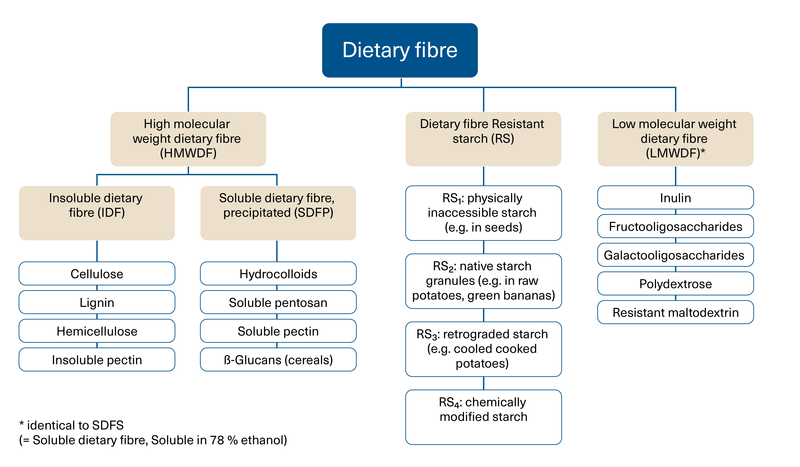
As presented in Figure 1, dietary fibre can be ascribed to various categories according to molecular weight and solubility. High molecular fibre (High Molecular Weight Dietary Fibre, HMWDF) with a degree of polymerisation of ≥ 10 can be divided into water-soluble (Soluble Dietary Fibre, Precipitated,SDFP) and water-insoluble (insoluble Dietary Fibre, IDF) high molecular fibre. Resistant starch (RS) is classified in up to four different categories from RS1 to RS4. The Low Molecular Weight Dietary Fibre (LMWDF) category contains carbohydrates with a degree of polymerisation of three to nine which are soluble in 78% ethanol and cannot be broken down by the human digestive system (SDFS). Due to its differing structures, dietary fibre has different characteristics which eventually lead to different physical and physiological effects (cf. section on the physiological effects of [various] dietary fibre).
Dietary fibre analysis
The total dietary fibre content is the sum of non-soluble (IDF) and soluble dietary fibre (SDFP and SDFS).
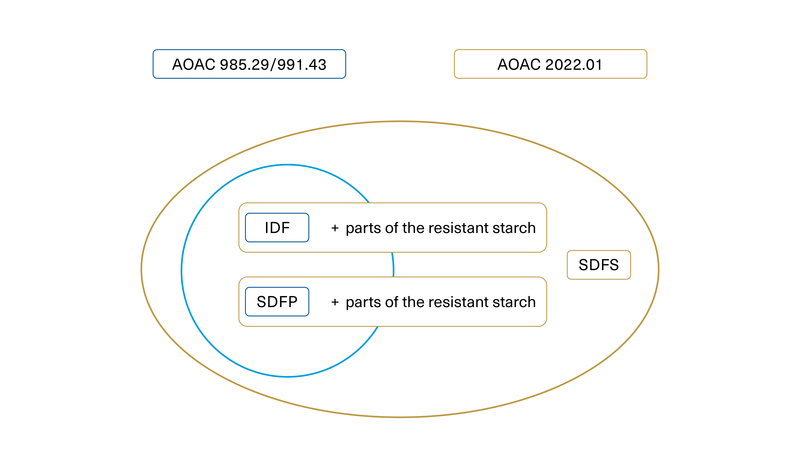
The dietary fibre data in BLS version 3.02 were determined using AOAC methods 985.29 and 991.43 [17, 18]. As described above, starting with BLS version 4.0, there will be a gradual transition to data analyzed using AOAC method 2022.01 [19]. Knowledge of the analytical method used is necessary for interpreting and applying the dietary fibre contents in the BLS. The dietary fibre listed in the current Codex Alimentarius definition is not recorded correctly when using the two older methods, AOAC 991.43 and 985.29. For the resistant starches in categories RS1 to RS3, the measured content is too low, for RS4, it is too high. The two older methods do not take SDFS into account. With regard to IDF and SDFP, there are no differences in the results of the methods used for the BLS. The current AOAC 2022.01 method enable the correct determination of IDF and SDFP, including resistant starches in categories RS1 to RS4 as well as SDFS, and thus records all dietary fibre [20]. Consequently, the AOAC 2022.01 method yields higher dietary fibre content compared to the two older methods.
The following illustration shows the dietary fibre that is taken into account using the two older methods, AOAC-991.43 and 985.29, in comparison with the newest AOAC method 2022.01:
Physiological effects of (various) dietary fibre
The health-promoting effects of dietary fibre are not based on a single mechanism but on the interaction of various physiological effects along the gastrointestinal tract as well as systemic metabolic processes. Two particular characteristics of dietary fibre play a crucial role in this: water solubility and fermentability, that is, the extent to which dietary fibre can be broken down by microorganisms in the gut, known as the microbiota, through fermentation. When insoluble dietary fibre, like cellulose, is eaten with sufficient fluid, it swells up and increases the stool volume, stimulating bowel motility and increasing the frequency of bowel movements [21]. If too little fluid is imbibed this dietary fibre can cause gastrointestinal discomfort, such as bloating or constipation. If eaten in very high quantities, it can also mildly impair the absorption of certain minerals; if a balanced diet is maintained, however, this is normally not clinically relevant [22]. It is almost impossible for human gut microbiota to ferment cellulose [23]. It therefore exerts its effects primarily through the physical properties described.
A key mechanism involves water-soluble dietary fibre such as pectins and β-glucans which increase the viscosity of the chyme in the stomach, thereby delaying gastric emptying [24, 25]. This effect continues in the small intestine and slows down the mixing with digestive enzymes as well as delaying the absorption of glucose and lipids [26]. This, in turn, causes post-prandial blood glucose and insulin spikes to flatten out, which improves long-term insulin sensitivity and is associated with a lower risk of type 2 diabetes mellitus [22, 27]. A delay in emptying the bowel also has a positive impact on feeling full. If the feeling of fullness begins earlier and lasts longer it can reduce energy intake and thus help prevent overweightness and obesity [24, 25, 28]. In parallel, some water-soluble dietary fibre, including pectins and β-glucans, can bind to bile acids in the small intestine and promote their excretion. The resulting increase in de novo synthesis of bile acids in the liver helps lower LDL cholesterol and thus reduces cardiovascular risk factors [29, 30].
In most cases, soluble dietary fibre is easily fermented by the gut microbiota, serving as a food source and, in the form of the compounds produced by fermentation, offering a raft of physiologically beneficial effects. A significant portion of dietary fibre is broken down into the short-chain fatty acids (SCFAs) acetate, propionate, and butyrate which primarily serve as an important source of energy for the lining of the large intestine [31]. Part of this is absorbed into the blood stream where, amongst other things, the SCFAs have anti-inflammatory effects, modulate lipid metabolism and influence glucose homeostasis [32–37]. In this way, the gut microbiota can influence systemic metabolism through these breakdown products.
The dietary fibre’s chemical structures produce diverse microbial metabolic pathways. A varied diet involving different plant foods is usually associated with the consumption of various types of dietary fibre as well as high ecological diversity in the gut microbiota [38]. An unbalanced diet involving few different types of dietary fibre, on the other hand, leads to less diversity in the microbiota [39]. If fermentable dietary fibre is missing from the diet altogether, significantly less SCFA is produced. Instead, the microbiota utilises to a greater extent other sources of nutrition like proteins. The fermentation of proteins produces branched-chain fatty acids (BCFAs) as well as compounds containing sulfur and nitrogen, such as hydrogen sulfide and ammonia, which, amongst other things, can have a toxic effect on intestinal tissue [31]. Regarding the prevention of cancers like colon cancer, butyrate and other SCFAs generally have a positive effect whereby other mechanisms also play a role. A shortish transit time, combined with a sufficiently high frequency of bowel movements, reduces exposure to carcinogenic substances. The latter include hydrogen sulfide, which is produced during protein fermentation. On the other hand, butyrate has been shown to have a protective effect against colorectal cancer and inflammatory reactions [8, 31, 40].
The fermentability of dietary fibre partly depends on the length of the molecule chain. Low molecular dietary fibre like FOS is characterised by particularly fast, intensive SCFA production. However, when produced in excess, the gases generated as byproducts of fermentation (primarily hydrogen and carbon dioxide) can no longer be effectively removed via the bloodstream or reused by the microbiota. This is the main reason for bloating and flatulence which are often seen as negative side-effects of a high-fibre diet [24, 39-41]. But the gut microbiota can adapt to an increased intake of fermentable dietary fibre, as a result of which the gut becomes habituated and the undesirable effects gradually decrease [40, 42].
Resistant starches occupy a special place. In the large intestine, they are preferentially fermented into butyrate, which serves as the most important energy source for the cells of the large intestine mucosa and plays a crucial role in maintaining the integrity of the intestinal barrier. An intact intestinal barrier prevents inflammatory substances from entering the circulatory system and thus reduces systemic inflammatory processes [43, 44]. Consuming too much resistant starch can also lead to gastrointestinal discomfort which, however, is usually less painful than that caused by rapidly fermentable oligosaccharides.
Apart from the characteristics of dietary fibre itself, the composition and matrix of high-fibre foods is very important. High-fibre foods are often also rich in secondary phytochemicals such as carotenoids and polyphenols [26]. Moreover, health-promoting effects normally occur in the combination of the individual physiological effects of dietary fibre, secondary phytochemicals and other nutritional components [45].
A varied intake of different plant-based food is therefore explicitly recommendable, as also stated in national nutrition recommendations [1, 5]. The reference value for dietary fibre intake of at least 30g/day [1,41] is primarily based on the positive effects that have been observed in the prevention of chronic disease. Physiologically, no strict distinction is made between low and high molecular weight dietary fibre. Rather, what counts is the total intake and the resulting effects on the body. As even low molecular weight dietary fibre and resistant starches present relevant physiological effects, in principle, they can count towards the reference value. The evidence for the current intake recommendation of 30 g/day derives from a state of research in which the content of dietary fibre was analysed using the older AOAC methods.
Conclusion
Dietary fibre is a significant part of a healthy diet. According to the representative consumption data available, however, in Germany less than the recommended amount is consumed on average. The use of AOAC method 2022.01 captures additional fractions of dietary fibre, resulting in higher dietary fibre contents being reported for numerous foods in BLS Version 4.0, even though their actual composition has not changed. As food groups that are relevant with regard to dietary fibre, such as bread, cereals and baked goods, have already been thoroughly updated, these changes have a considerable impact on the dietary fibre data in the BLS.
It is important to conduct a comprehensive analytical assessment of dietary fibre, as it unleashes a wide range of effects in the human body that depend heavily on its structural properties, such as solubility and fermentability. Both high molecular weight and low molecular weight dietary fibre, including resistant starches, contribute to different health effects in various ways. It is, therefore, not only the entire intake of dietary fibre that is decisive for the health-promoting effect but also the diversity of high-fibre foods. Against this backdrop, the MRI concurs with the valid recommendations for varied, plant-based diet. Currently, there is a lack of data on whether meeting the recommended intake more easily by consuming low molecular weight, rapidly fermentable dietary fibre – as measured by AOAC method 2022.01 – is actually associated with the same long-term health benefits, or whether the recommendations need to be adjusted to ensure optimum physiological effects.
- AOAC: Association of Official Analytical Collaboration
- BCFA: Verzweigtkettige Fettsäuren (Branched Chain Fatty Acids)
- BLS: Bundeslebensmittelschlüssel
- DGE: Deutsche Gesellschaft für Ernährung
- FOS: Frukto-Oligosaccharide
- HMWDF: Hochmolekulare Ballaststoffe (High Molecular Weight Dietary Fibre)
- IDF: Unlösliche Ballaststoffe (Insoluble Dietary Fibre)
- LMWDF: Niedermolekulare Ballaststoffe (Low Molecular Weight Dietary Fibre)
- MRI: Max Rubner-Institut
- RS: Resistente Stärke
- SCFA: Kurzkettige Fettsäuren (Short Chain Fatty Acids)
- SDFP: Ausfällbare lösliche Ballaststoffe(Soluble Dietary Fibre, Precipitated)
- SDFS: Lösliche Ballaststoffe, Ethanol-löslich (Soluble Dietary Fibre, Soluble in 78 % Ethanol)
- Deutsche Gesellschaft für Ernährung e.V. (DGE): Referenzwerte für die Nährstoffzufuhr. 3. Auflage, Bonn, 2025
- Max Rubner-Institut: Nationale Verzehrsstudie II - Ergebnisbericht Teil 2, 2008, Internet: www.mri.bund.de/fileadmin/MRI/Institute/EV/NVSII_Abschlussbericht_Teil_2.pdf (accessed 12.06.2026)
- Krems C, Walter C, Heuer T, Hoffmann I: Lebensmittelverzehr und Nährstoffzufuhr – Ergebnisse der Nationalen Verzehrsstudie II. In: 12. Ernährungsbericht 2012. Deutsche Gesellschaft für Ernährung e. V., Bonn, 2012, Internet: www.dge.de/fileadmin/dok/wissenschaft/ernaehrungsberichte/12eb/12.Ern%C3%A4hrungsbericht_2012_20121125.pdf (accessed 12.06.2026)
- GBD 2021 Risk Factors Collaborators: Global burden and strength of evidence for 88 risk factors in 204 countries and 811 subnational locations, 1990–2021: a systematic analysis for the Global Burden of Disease Study 2021. The Lancet 403 (10440), 2162-2203, 2024, doi: 10.1016/S0140-6736(24)00933-4
- Reynolds A, Mann J, Cummings J, Winter N, Mete E, Te Morenga L: Carbohydrate quality and human health: a series of systematic reviews and meta-analyses. The Lancet 393 (10170), 434-445, 2019, doi: 10.1016/S0140-6736(18)31809-9
- Riccardi G, Costabile G: Carbohydrate quality is key for a healthy and sustainable diet. Nature Reviews Endocrinology 15 (5), 257-258, 2019, doi: 10.1038/s41574-019-0190-x
- Veronese N, Solmi M, Caruso MG, Giannelli G, Osella AR, Evangelou E, Maggi S, Fontana L, Stubbs B, Tzoulaki I: Dietary fiber and health outcomes: an umbrella review of systematic reviews and meta-analyses. The American Journal of Clinical Nutrition 107 (3), 436-444, 2018, doi: 10.1093/ajcn/nqx082
- World Cancer Research Fund/American Institute for Cancer Research: Diet, Nutrition, Physical. Activity and Cancer: a Global Perspective. A summary of the Third Expert Report, 2018, Internet: www.wcrf.org/wp-content/uploads/2024/11/Summary-of-Third-Expert-Report-2018.pdf (accessed 12.06.2026)
- Aune D, Chan DSM, Lau R, Vieira R, Greenwood DC, Kampman E, Norat T: Dietary fibre, whole grains, and risk of colorectal cancer: systematic review and dose-response meta-analysis of prospective studies. British Medical Journal 343, d6617, 2011, doi: 10.1136/bmj.d6617
- Tobaruela EC, Santos AO, Almeida-Muradian LB, Araujo EDS, Lajolo FM, Menezes EW: Application of dietary fiber method AOAC 2011.25 in fruit and comparison with AOAC 991.43 method. Food Chemistry 238, 87-93, 2018, doi: 10.1016/j.foodchem.2016.12.068
- Pferdmenges LE, Lohmayer R, Frommherz L, Brühl L, Hüsken A, Mayer-Miebach E, Meinhardt AK, Ostermeyer U, Sciurba E, Zentgraf H, Schröter A, Begemann J, Schmidt M: Overview of the nutrient composition of selected milling products from rye, spelt and wheat in Germany. Journal of Food Composition and Analysis 140, 2025, doi: 10.1016/j.jfca.2025.107275
- Rubner M: Die Verdaulichkeit von Weizenbrot. Archiv für Anatomie und Physiologie / Physiologische Abteilung, 61-92, 1916
- Hipsley EH: Dietary “Fibre” and Pregnancy Toxaemia. British Medical Journal 2 (4833), 420-422, 1953, doi: 10.1136/bmj.2.4833.420
- Trowell H, Southgate DAT, Wolever TMS, Leeds AR, Gassull MA, Jenkins DJA: Dietary Fibre Redefined. The Lancet 307 (7966), 967, 1976, doi: 10.1016/S0140-6736(76)92750-1
- Food and Agriculture Organization of the United Nations: Guidelines on Nutrition Labelling CXG 2-1985; Adopted in 1985. Revised in 1993 and 2011. Amended in 2003, 2006, 2009, 2010, 2012, 2013, 2015, 2016, 2017, 2021 and 2024. 2024, Internet: www.fao.org/fao-who-codexalimentarius/sh-proxy/en/ (accessed 26.05.2026)
- Europäisches Parlament und Rat der Europäischen Union: Verordnung (EU) Nr. 1169/2011 des Europäischen Parlaments und des Rates vom 25. Oktober 2011 betreffend die Information der Verbraucher über Lebensmittel und zur Änderung der Verordnungen (EG) Nr. 1924/2006 und (EG) Nr. 1925/2006 des Europäischen Parlaments und des Rates und zur Aufhebung der Richtlinie 87/250/EWG der Kommission, der Richtlinie 90/496/EWG des Rates, der Richtlinie 1999/10/EG der Kommission, der Richtlinie 2000/13/EG des Europäischen Parlaments und des Rates, der Richtlinien 2002/67/EG und 2008/5/EG der Kommission und der Verordnung (EG) Nr. 608/2004 der Kommission. 2011, Internet: eur-lex.europa.eu/legal-content/DE/TXT/PDF/ (accessed 12.06.2026)
- AOAC International: Official Methods of Analysis. 2020
- Bundesministerium der Justiz und für Verbraucherschutz BfJ: Lebensmittel- und Futtermittelgesetzbuch (LFGB) in der Fassung der Bekanntmachung vom 15. September 2021 (BGBl. I S. 4253), das zuletzt durch Artikel 1 des Gesetzes vom 2. März 2023 (BGBl. 2023 I Nr. 56) geändert worden ist., 2005, Internet: www.gesetze-im-internet.de/lfgb/ (accessed 18.05.2026)
- Latimer GW: Official Methods of Analysis of AOAC INTERNATIONAL. AOAC Publications, New York, 22nd Edition, 2023, doi: 10.1093/9780197610145.001.0001
- McCleary BV: Measurement of Dietary Fiber: Which AOAC Official Method of Analysis to Use. Journal of AOAC INTERNATIONAL 106 (4), 917-930, 2023, doi: 10.1093/jaoacint/qsad051
- Dahl WJ, Stewart ML: Position of the Academy of Nutrition and Dietetics: Health Implications of Dietary Fiber. Journal of the Academy of Nutrition and Dietetics 115 (11), 1861-1870, 2015, doi: 10.1016/j.jand.2015.09.003
- Weickert MO, Pfeiffer AFH: Impact of Dietary Fiber Consumption on Insulin Resistance and the Prevention of Type 2 Diabetes. The Journal of Nutrition 148 (1), 7-12, 2018, doi: 10.1093/jn/nxx008
- Hamaker BR, Tuncil YE: A perspective on the complexity of dietary fiber structures and their potential effect on the gut microbiota. Journal of Molecular Biology 426 (23), 3838-3850, 2014, doi: 10.1016/j.jmb.2014.07.028
- Clark MJ, Slavin JL: The Effect of Fiber on Satiety and Food Intake: A Systematic Review. Journal of the American College of Nutrition 32 (3), 200-211, 2013, doi: 10.1080/07315724.2013.791194
- Wanders AJ, van den Borne JJGC, de Graaf C, Hulshof T, Jonathan MC, Kristensen M, Mars M, Schols HA, Feskens EJM: Effects of dietary fibre on subjective appetite, energy intake and body weight: a systematic review of randomized controlled trials. Obesity Reviews 12 (9), 724-739, 2011, doi: 10.1111/j.1467-789X.2011.00895.x
- Williams BA, Grant LJ, Gidley MJ, Mikkelsen D: Gut Fermentation of Dietary Fibres: Physico-Chemistry of Plant Cell Walls and Implications for Health. International Journal of Molecular Sciences 18 (10), 2017, doi: 10.3390/ijms18102203
- Lu K, Yu T, Cao X, Xia H, Wang S, Sun G, Chen L, Liao W: Effect of viscous soluble dietary fiber on glucose and lipid metabolism in patients with type 2 diabetes mellitus: a systematic review and meta-analysis on randomized clinical trials. Frontiers in Nutrition 10, 1253312, 2023, doi: 10.3389/fnut.2023.1253312
- Jovanovski E, Mazhar N, Komishon A, Khayyat R, Li D, Blanco Mejia S, Khan T, L Jenkins A, Smircic-Duvnjak L, Sievenpiper JL, Vuksan V: Can dietary viscous fiber affect body weight independently of an energy-restrictive diet? A systematic review and meta-analysis of randomized controlled trials. The American Journal of Clinical Nutrition 111 (2), 471-485, 2020, doi: 10.1093/ajcn/nqz292
- Ho HVT, Sievenpiper JL, Zurbau A, Mejia SB, Jovanovski E, Au-Yeung F, Jenkins AL, Vuksan V: A systematic review and meta-analysis of randomized controlled trials of the effect of barley β-glucan on LDL-C, non-HDL-C and apoB for cardiovascular disease risk reductioni-iv. European Journal of Clinical Nutrition 70 (11), 1239-1245, 2016, doi: 10.1038/ejcn.2016.89
- Whitehead A, Beck EJ, Tosh S, Wolever TMS: Cholesterol-lowering effects of oat β-glucan: a meta-analysis of randomized controlled trials1234. The American Journal of Clinical Nutrition 100 (6), 1413-1421, 2014, doi: 10.3945/ajcn.114.086108
- Macfarlane GT, Macfarlane S: Bacteria, Colonic Fermentation, and Gastrointestinal Health. Journal of AOAC INTERNATIONAL 95 (1), 50-60, 2012, doi: 10.5740/jaoacint.SGE_Macfarlane
- Koh A, De Vadder F, Kovatcheva-Datchary P, Bäckhed F: From Dietary Fiber to Host Physiology: Short-Chain Fatty Acids as Key Bacterial Metabolites. Cell 165 (6), 1332-1345, 2016, doi: 10.1016/j.cell.2016.05.041
- Fan Y, Pedersen O: Gut microbiota in human metabolic health and disease. Nature Reviews Microbiology 19 (1), 55-71, 2021, doi: 10.1038/s41579-020-0433-9
- den Besten G, van Eunen K, Groen AK, Venema K, Reijngoud D-J, Bakker BM: The role of short-chain fatty acids in the interplay between diet, gut microbiota, and host energy metabolism. Journal of Lipid Research 54 (9), 2325-2340, 2013, doi: 10.1194/jlr.R036012
- Chambers ES, Viardot A, Psichas A, Morrison DJ, Murphy KG, Zac-Varghese SEK, MacDougall K, Preston T, Tedford C, Finlayson GS, Blundell JE, Bell JD, Thomas EL, Mt-Isa S, Ashby D, Gibson GR, Kolida S, Dhillo WS, Bloom SR, Morley W, Clegg S, Frost G: Effects of targeted delivery of propionate to the human colon on appetite regulation, body weight maintenance and adiposity in overweight adults. Gut 64 (11), 1744-1754, 2015, doi: 10.1136/gutjnl-2014-307913
- Chambers ES, Byrne CS, Morrison DJ, Murphy KG, Preston T, Tedford C, Garcia-Perez I, Fountana S, Serrano-Contreras JI, Holmes E, Reynolds CJ, Roberts JF, Boyton RJ, Altmann DM, McDonald JAK, Marchesi JR, Akbar AN, Riddell NE, Wallis GA, Frost GS: Dietary supplementation with inulin-propionate ester or inulin improves insulin sensitivity in adults with overweight and obesity with distinct effects on the gut microbiota, plasma metabolome and systemic inflammatory responses: a randomised cross-over trial. Gut 68 (8), 1430, 2019, doi: 10.1136/gutjnl-2019-318424
- Canfora EE, Jocken JW, Blaak EE: Short-chain fatty acids in control of body weight and insulin sensitivity. Nature Reviews Endocrinology 11 (10), 577-591, 2015, doi: 10.1038/nrendo.2015.128
- McDonald D, Hyde E, Debelius JW, Morton JT, Gonzalez A, Ackermann G, Aksenov AA, Behsaz B, Brennan C, Chen Y, DeRight Goldasich L, Dorrestein PC, Dunn RR, Fahimipour AK, Gaffney J, Gilbert JA, Gogul G, Green JL, Hugenholtz P, Humphrey G, Huttenhower C, Jackson MA, Janssen S, Jeste DV, Jiang L, Kelley ST, Knights D, Kosciolek T, Ladau J, Leach J, Marotz C, Meleshko D, Melnik AV, Metcalf JL, Mohimani H, Montassier E, Navas-Molina J, Nguyen TT, Peddada S, Pevzner P, Pollard KS, Rahnavard G, Robbins-Pianka A, Sangwan N, Shorenstein J, Smarr L, Song SJ, Spector T, Swafford AD, Thackray VG, Thompson LR, Tripathi A, Vazquez-Baeza Y, Vrbanac A, Wischmeyer P, Wolfe E, Zhu Q, American Gut C, Knight R: American Gut: an Open Platform for Citizen Science Microbiome Research. mSystems 3 (3), 2018, doi: 10.1128/mSystems.00031-18
- Vinelli V, Biscotti P, Martini D, Del Bo C, Marino M, Merono T, Nikoloudaki O, Calabrese FM, Turroni S, Taverniti V, Union Caballero A, Andres-Lacueva C, Porrini M, Gobbetti M, De Angelis M, Brigidi P, Pinart M, Nimptsch K, Guglielmetti S, Riso P: Effects of Dietary Fibers on Short-Chain Fatty Acids and Gut Microbiota Composition in Healthy Adults: A Systematic Review. Nutrients 14 (13), 2022, doi: 10.3390/nu14132559
- Mutuyemungu E, Singh M, Liu S, Rose DJ: Intestinal gas production by the gut microbiota: A review. Journal of Functional Foods 100, 2023, doi: 10.1016/j.jff.2022.105367
- EFSA Panel on Dietetic Products N, and Allergies (NDA);: Scientific Opinion on Dietary Reference Values for carbohydrates and dietary fibre. EFSA Journal 8 (3), 2010, doi: 10.2903/j.efsa.2010.1462
- Scott KP, Gratz SW, Sheridan PO, Flint HJ, Duncan SH: The influence of diet on the gut microbiota. Pharmacological Research 69 (1), 52-60, 2013, doi: 10.1016/j.phrs.2012.10.020
- Louis P, Flint HJ: Formation of propionate and butyrate by the human colonic microbiota. Environmental Microbiology 19 (1), 29-41, 2017, doi: 10.1111/1462-2920.13589
- Makki K, Deehan EC, Walter J, Bäckhed F: The Impact of Dietary Fiber on Gut Microbiota in Host Health and Disease. Cell Host & Microbe 23 (6), 705-715, 2018, doi: 10.1016/j.chom.2018.05.012
- Tuohy KM, Conterno L, Gasperotti M, Viola R: Up-regulating the human intestinal microbiome using whole plant foods, polyphenols, and/or fiber. Journal of Agricultural and Food Chemistry 60 (36), 8776-8782, 2012, doi: 10.1021/jf2053959